
Preventing Deer From Rubbing on Young Trees Over Winter
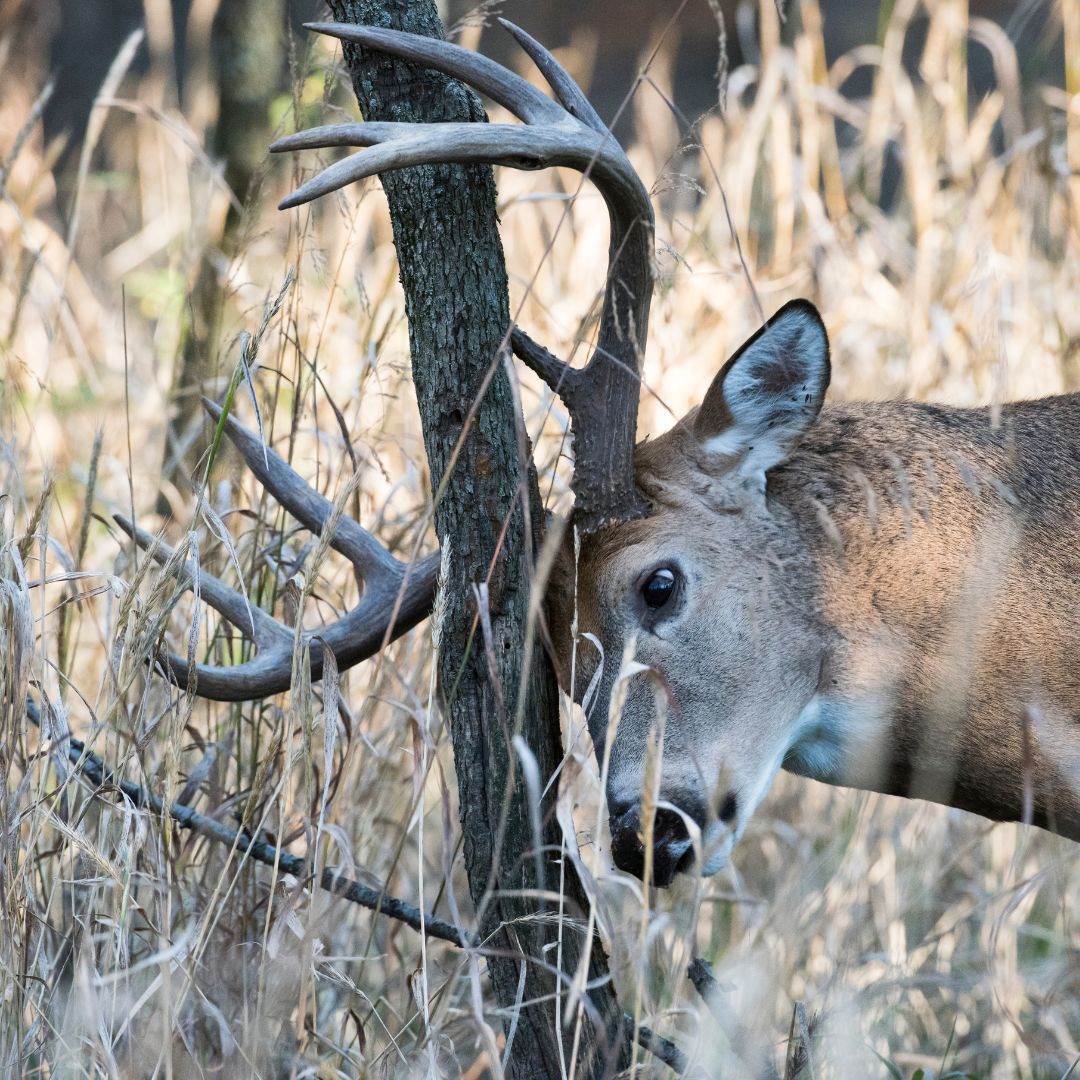
This one is from Betsy, who says, “good morning. We noticed on our little tree that we planted this summer that a deer we think has scratched or rubbed the trunk. What could we do to protect that damaged area and keep it from dying? If anything it’s surface damage, not too deep.”
Okay, good. What I would recommend is bringing a picture into one of the two nurseries. And the solution is also at one of the two nurseries. We have these cages we wrap around the trunks this time of year. It’s like a plastic guard, and when that foreign object is on the trunk the deer will not mess with it.
If you come into the nursery this time of year you’ll see every single tree in our nursery has a cage around it. It protects that trunk and unfortunately this is something to be aware of when they rub that tree. There’s a scent gland at the base of their antler and that marks that territory.
Well, the next buck that comes through with antlers, smells that and says oh, no, this is my territory. So once one deer has rubbed that, the likelihood of it being re-rubbed by another deer is significantly higher. So if you put that cage on it, it should stop that from happening.
If a tree is hemorrhaging, and it’s pushing out a lot of sap, then we will use a sealant on it. But if that’s not the case, if it’s not pushing out excessive amounts of sap, then generally we won’t do that because once that tar hardens on the outside, you can’t see what’s going on on the inside. A lot of times a cut on us will heal better open to the air than it does covered. Same idea with the tree basically. We will recommend a good dose of fertilizer in the spring to help the tree recover from that damage.
Usually when they rub the trunk, the bark on either side of the rub will get thicker the next spring. It’s basically carrying the nutrients up that that missing bark would normally be carrying, and as that thicker side where the where the damage is, on the sides that will get thicker and thicker and thicker and will actually grow back together. Now if the deer rub more than 50% of the way around the tree, the further around the tree it rubbed the more likely the tree is not going to recover. Because just inside the outer bark is the cambium where the fluid flows up and down, all the nutrients are moved up and down just inside usually the last couple years of growth. So the center of the tree is more there for support. All of the growth, the live part of the tree is on the outer bark, so by bringing that picture in we’ll be able to take a look at it at either one of the Rohr’s Nursery locations. We have the guards available to protect the trees at either location as well. And it’s sometimes the trees out in the middle of yard, completely by their self that the deer go after as a marking post. They like them somewhere between about thumb size caliper all the way up to about two and a half three inches in caliper. Anything larger than that generally they leave alone.
I remember a few years ago, there was an issue with $3,000 in trees in one night. Just not sellable. We pretty much have a rule now that by August, first week or second week in August, I want all of the trees to be caged. And it’s crazy because I mean you couldn’t push the cage out of the way. It’s a really easy thing to put on, but it’s almost like a wrap. At the growing nurseries, they use them by the tens of thousands to protect their fields. Some of them have gone to electric fences to try to protect their field.
There’s a lot of things that are done out there to try to deter deer. There’s even a manufacturer that makes soap packets that have like twisty ties on the end of a soap packet, and it hangs and it irritates their eyes. Cutting up a bar of Irish Spring soap and hanging it with the twist tie is another way that you can naturally deter them, as well as Repels-All and several of the other granulars. The problem with those is they go on the ground, so when later in the year, this rubbing action will happen all the way through the breeding season. The breeding season starts now or about two weeks ago, and will run basically all the way through first second week of February. Most of it happens in the next four or four weeks here, but it does continue on to that point. So in the winter if you have the Repels All on the ground, you’re not really getting that effervescent smell because the snow is holding it down. That’s why a cage on the tree or a hanging piece of soap or something like that will work as a deterrent through the entire winter season.
Questions? Email us at [email protected] or call one of our two locations: Portage (330-499-0101) or Everhard (330-492-1243).