Using Wilt Proof to Protect your Plants
Karen in Canton Township asks, ‘I have a question about wilt proof. Is it too soon to put it on? Is one application all we need or will we have to do it a second time?’
I think it’s a touch early yet. The reason I’m saying that is I want to make sure the plants are completely dormant when that product’s put on. The cold that we’ve had finally shut 90% of things down, but it’s not going to hurt to wait a little longer.
The residual on that product’s only about 30 to 45 days, depending on the sunlight and the moisture that we get. So by waiting till after Thanksgiving but before Christmas, you only need it to be above freezing for a couple hours after you apply that. You just want the liquid to be able to dry on the leaf.
You don’t have to worry about it, you know, not raining for three days or being dry and above freezing for eight or ten hours. You just need it to let that liquid dry on the leaf in the sunlight, and it’ll be more effective.
The first application is by far the most important. Now, a lot of times we’ll get what we call a January thaw where we warm back up, we’ll have a week or so where it’s really nice again. If that happens towards the end of January, absolutely you can do a second application of it. Two applications is better than one, but the first application is the one that’s crucial.
The japonica, rhododendrons, azaleas, boxwood, it is extremely important for protecting those plants. It’s kind of like a liquid chapstick. It just protects those plants from that cold winter wind and they come out of winter when they wake up in the spring with no winter damage and then that plant just can grow that much better the next year because there was no foliage damage.
There’s still some effectiveness beyond that time frame, but that time frame is when it’s the most effective and the first application is crucial. That’s the one you’ll see the biggest difference between doing and not doing. That second application, you’ll see some difference, but there’s some years where we’re just not above freezing.
I mean, I can remember winters where we got below freezing in December and that was it until March. I mean, we’re not going above again and if that happens, then you’re not really able to apply that product properly because it has to be above freezing for a few hours for it to dry, but I would say most years here in Ohio, we are going to have that thaw out a little bit and you’re like, we’ll see some days in the low 40s, high 30s. And you want to get out there.
And if you want to do something, that is like she said, if you’ve ever had a japonica or an azalea or a rhododendron and not sprayed it and then sprayed it one year, the way it comes through the winter is a night and day difference.
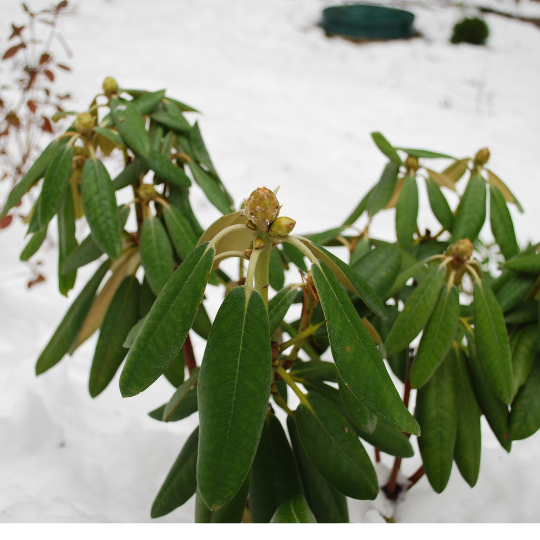
Especially with rhododendrons. The leaf is so large on a rhododendron, it’s so easy for that winter wind to dehydrate that leaf and then it burns brown all the way around the margin of the leaf. And if it damages too much of the leaf in the springtime, the plant will look at that leaf and say, okay, it’s not making me enough food, and it will drop it. Then they get all skeletonized and they’re not full and thick and beautiful.
If they’re protected from the winter wind like on the east side of the house, it’s less likely to happen, but we can have some crazy cold nor’easters blow in and can damage it on all sides of the house. If you have the product, it’s just better to put it on it. It will protect the plants and they’ll come through winter.
And remember, with rhododendrons and azaleas specifically, their buds are set right now for next year already. So you’re not only protecting the foliage, you’re protecting the flowers, which, let’s face it, that’s why we plant those things. They get softball sized beautiful flowers on them in the spring. We want to make sure that bud doesn’t dry out and makes it to spring so we can see the flowers.
Questions? Email us at [email protected] or call one of our two locations: Portage (330-499-0101) or Everhard (330-492-1243).
