Dealing with Powdery Mildew & Gall on Old Oaks
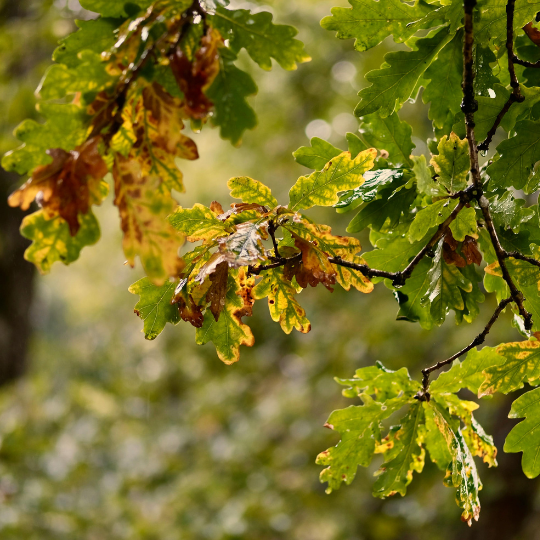
Lynn in North Canton says, ‘Good morning. I have a question regarding my oak trees. I just recently had them trimmed and the gentleman doing the work told me that they have powdery mildew and one of them has oak apples.’
The powdery mildew is an environmental thing. It generally doesn’t come back season to season. It is important to clean those leaves up as they drop, remove them from the area. So I would bag those. You don’t want to encourage the fungus to come back. High humidity and a lot of moisture in the air can create powdery mildew on the leaves. It’s generally not something that will kill a tree.
The oak apples, I’m not 100% sure what he’s talking about there. It may be gall. There’s gall that can happen on the branching and gall that can happen on the leaves. And there’s two different insects that cause that problem.
If you have gall on the branches themselves, you want to trim back about six inches behind where the gall is formed and just remove it off of the tree. The ones that happen on the leaves are nothing to worry about.It’s a microscopic insect that basically stings the leaf in its reproduction process, and then it causes it to grow this little furry ball on top of the leaf.
Also, generally not something that’s going to kill the tree. And some years you’ll see it, some years you won’t. It’s kind of like a clock pendulum. It’ll swing back and forth. Sometimes we see a bunch of it. Sometimes we see very little of it. A lot of that has to do with just environmental changes. The best thing you can do for the tree is just fertilize it in the spring, keep it healthy, and then it’ll fight off most of the problems that could happen.
I would use an all-season fertilizer, something that’s going to fertilize it for the entire growing season. The Rohr’s Nursery all-season fertilizer we have, it’s a green pellet. It will actually feed that tree for the entire growing season. So you only have to apply it once in the spring.
Sometimes there’s common names on stuff, and we may not have heard it by that common name before. Gall’s pretty common on oak. We see it from time to time. It’s generally nothing that, like I said, was going to kill the tree, but it is something that we, if we keep the tree healthy, just like us, I mean, we’ll take vitamin C certain times a year when the temperatures are changing just to, you know, boost our immune system. That’s what fertilizing is for the tree. You’re going to keep that tree healthy by just making sure it has the nutrients that it needs to grow properly.
If you have somebody there that’s trimming your trees, and they say, well, your trees have this, it could be very scary, not knowing what to do. Sometimes, like with an oak tree, I have 70 footers. I can’t spray that. My step ladder is not quite that tall.
What we’ll do in a situation like that is we’ll use a systemic insecticide, and that could go down in the spring, same time as we’re putting the all-season fertilizer down, and it’ll draw it up through the sap system of the tree. It’s the best way to protect large trees that aren’t really conducive to spraying.
Questions? Email us at [email protected] or call one of our two locations: Portage (330-499-0101) or Everhard (330-492-1243).

 SYRINGA X BLOOMERANG® DK PURPLE G1 PW