Grass Seeding This Fall & What Seed to Get
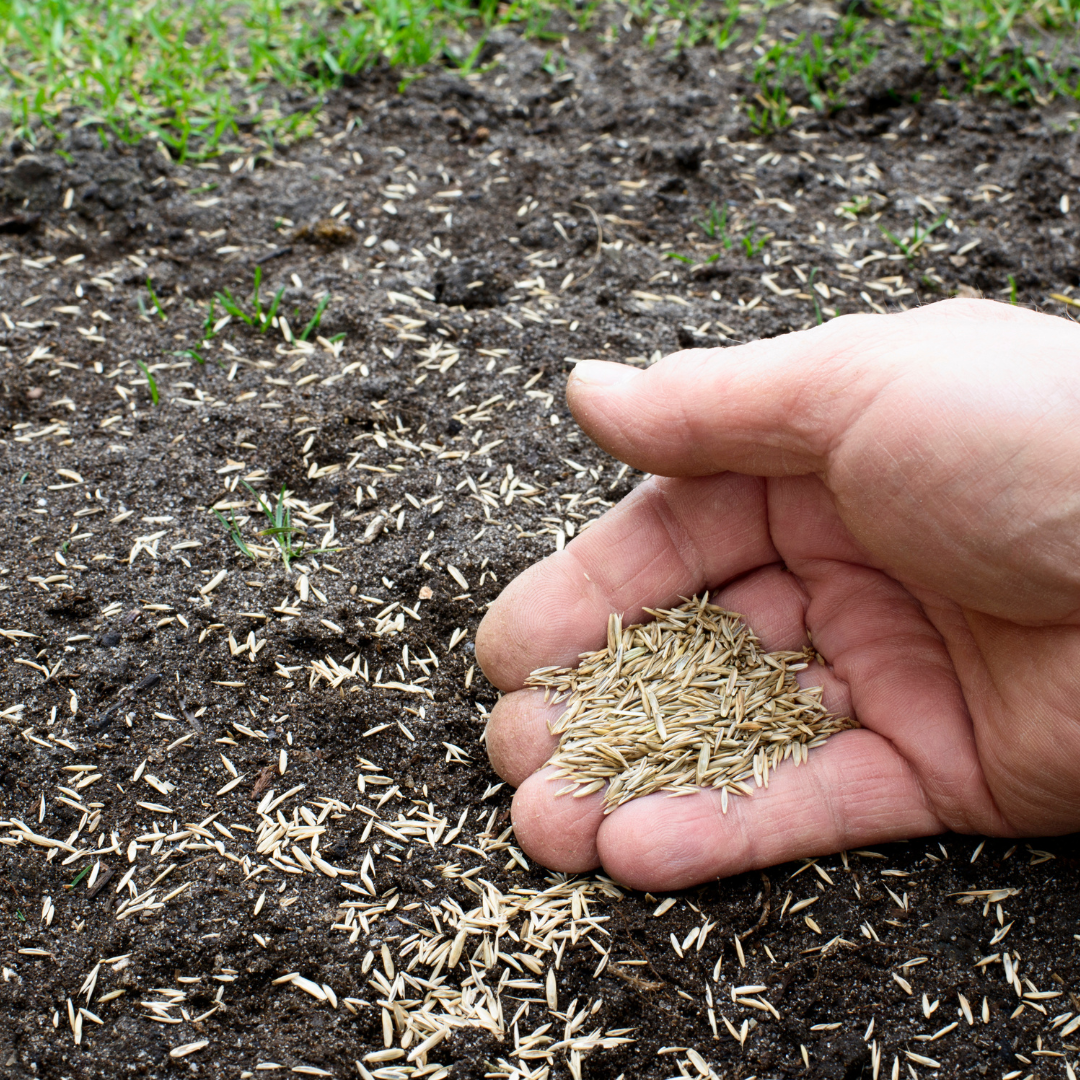
I want to talk about grass seeding, it’s the time of year. The rain is what we’ve been waiting on.
And anybody that’s done lawn repair in the last several weeks, if it wasn’t getting watered multiple times a day, not just once a day, if the top quarter inch of soil dries out, you lose that seed because that’s all the bigger the root is when it first starts to grow.
Now that Mother Nature is helping us, and you need the soil temps to be above 50, we are definitely there. We’re going down to around 50 at night and then up into the 70s in the day, and we’ve got moisture. Those are the perfect environments to reseed the grass in the yard, do the spot repair.
So this is the time of year we want to do that. We want to get out there, get that seed spread, I use Sweet Peet. The same thing we actually use to plant the trees. You can take that and kind of crush it between your hands, and it creates almost like a peat moss powder that will fall onto the ground and it will cover the seed. It’s so much cleaner than straw.
Now spreading it is a little messier than straw because you want to wear gloves. But it’s going to fertilize, too, it’s also going to break down and become part of the soil, so it’s going to continue to help the seed long after it helps it germinate. You won’t have to rake it up like you do straw.
Regular peat moss is really acidic, and grass likes the soil pH between 7 and 7.5. So a real acidic peat moss going down at a 4 or 5 isn’t going to help that grass in any way. The Sweet Peet is designed to actually be used for that as well as planting trees.
What Kind of Grass Seed Do You Need?
Almost all grass seeds, at least everything we sell at the nursery, are a blend. It’s not just bluegrass. It’s not just perennial rye. It’s not just fescue. There’s different types of fescues as well. There’s a tall fescue, which we don’t have that in any of our blends. A creeping fescue, a perennial rye.
So a creeping fescue will germinate in about 7 to 10 days. Perennial rye, about 10 to 14 days. And then bluegrass can take as long as 21 days to germinate, sometimes even 28 days.
35 to 50 percent should be in that bluegrass family. And then you want some perennial rye and some fescue in there. The perennial rye is very robust, very hardy, and will handle the drought and the heat much better than bluegrass. But bluegrass gives it that lush, bluish green color and is really thick because there’s a lot of seeds that are in a pound of bluegrass.
And that’s why we blend it, because we kind of want a little bit of everything. If we just did bluegrass, everything would look dead by July 4th. It’s just too hot, too dry. That plant doesn’t thrive. Now, it doesn’t die most of the time, it just goes dormant. Now, this year we were dry for, at least at the nursery, for over 50 days. That’s long enough that you could have gotten the crown of the plant and the root systems of the plant too far dehydrated.
With this rain within 7 to 10 days, you can put some fertilizer on now that we’ve had some rain and we’re in the cooler temperatures. The grass is going to naturally wake up from that moisture in the cooler temperatures. Bluegrass especially likes the cool spring and cool fall. That’s when it’s going to do the best.
And I only say that because you don’t want to wait too late in the year. Remember, it takes 21 to 28 days for bluegrass seed to germinate. If you put it down in November, we’re not going to have 28 days above 50 degrees. So that’s why right now, and I would have said it even earlier, but we just didn’t have any rain. I didn’t want to encourage people to not have success because most people aren’t going to water it as often as it would have needed before. Now that we’re cooler, we’re getting some rain from Mother Nature. It’s going to help that seed really germinate and grow well.
Questions? Email us at [email protected] or call one of our two locations: Portage (330-499-0101) or Everhard (330-492-1243).
