Salvaging a Struggling Schefflera & Pruning Houseplants
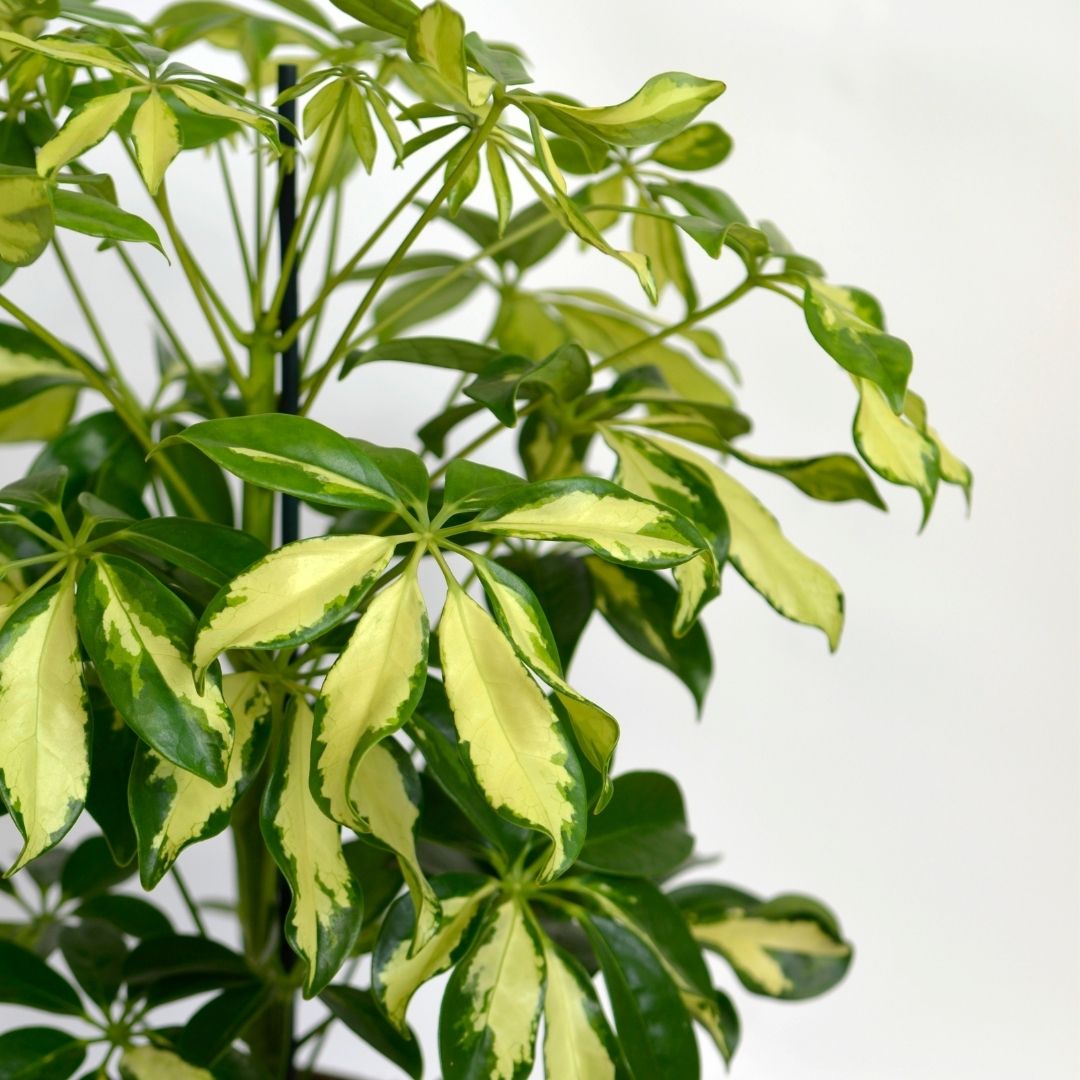
The email says, ‘good morning. I sent these two pictures, and if there’s any hope for the plant to regrow its branches and leaves in the bottom, you can see the top has green on it. I received this in 2005. It was so full and beautiful. We couldn’t see through it. It’s about three feet tall.’
It’s a schefflera. It just needs a little bit of maintenance. So any of the brown that is dead, you want to get rid of that. And it does need a good trim. A lot of that green is going to need to be cut back. It might look a little drastic at first, it’s going to look like sticks. Now is a good time to do it. You can go ahead and, and fertilize it with like the Rohr’s all season, the granular, and you can use a liquid fertilizer when you water too. After you trim, that’ll help it bush out new growth. So you double feed it. That’s going to really help it.
Another thing that’s a really good idea is when it does get nice and the fear of frost is gone, you can take it outside. You want to make sure you keep it in a shady area away from direct sun, usually because they don’t like really direct sun anyway. And being that it’s in the house, it would burn the leaves, so just make sure you put it in the shade, but that will really help it bush back out. Trimming and fertilizing is really the main thing.
So what we’re looking at here, just to describe it to people, there’s a bunch of lower sticks. It looks like they got trimmed a long time ago. And what you can do is take the edge of your pruner and just scratch that bark. If that bark’s not green underneath, it’s not coming back. There’s no point in leaving that dead wood on. Let’s take it off.
It’ll allow light air and moisture to get down to the base of the plant better. And then we’re going to trim the live stuff back. You probably could go about half of that. You would kind of just want to stagger it a little bit and, and yeah, it is going to look a little weird, but doing that is going to push out more growth into the center and make it more bushy. And then with the fertilizer, that’s going to really allow it, with a lot of nitrogen, to push out and grow.
Even on the sticks on the bottom where you see no foliage growing right now, there are buds inside there. And when you trim that top off, the plant’s going to send enough energy up. And hopefully if we’re double feeding it, it’s going to send a lot of energy up. And because that top’s not there anymore, it’s going to push all those buds that are inside that branching back out. And that’ll thicken the plant up.
Don’t fear the pruner, as we always like to say. Now is a good time of year. You do not want to trim things at the wrong time of year. If it’s something that she doesn’t feel comfortable doing herself, she’s more than welcome to bring that into the nursery. It’ll only take us a few minutes. We’ll work her through how we would trim it and we could do some trimming on it.
We do that a lot. A lot of times people will bring in plants, ‘can you repot this and baby it and doctor it back up?’ And yeah, we’ll repot it, fertilize it. We usually put systemic in it, which is an insect control. Trim it up and send it on its way. Send it home. It’s just like taking it to the quick clinic. Or if you want to do it yourself, you’re welcome to even bring this picture in and we can kind of show you exactly where we mean, or the plant itself, depending on how big it is.
It seems counterproductive, pruning that much. But whenever you do a hard pruning, and this is the same, whether we’re talking about house plants or trees and shrubs outside, anytime that level of pruning is done, following it up with a heavy dose of fertilizer, both slow release and quick release will help the plant recover very, very quickly. It’s only going to push as much growth out as it has nutrients to do.
So without the nutrients there, it could be catastrophic for that plant. It needs the nutrients to flush that growth back out down low. And as long as you do it at the right time of year and the right order, success is never guaranteed, but it’s a very high probability.
And in a month or two, you’re going to be like, oh my gosh, I’m so thankful I did that. It’s very satisfying, especially on schefflera. That’s a very forgiving, easy one to trim and it’ll be very pretty in no time. There are certain plants that are not forgiving.
Burning bush, smoke bush, they’re very forgiving of hard pruning, as long as you do it at the right time of year. Now you take that same burning bush and you try to trim it when it’s 95 degrees in the middle of July and you haven’t watered it and there’s no food and it’s already sent the energy up to grow the leaves, that is not a great situation. So anytime you want to do a hard pruning like that, we recommend that to happen here in March or April, early in the year.
And same with a lot of things like ficus and schefflera, your house plants that are a little bit more of like trees and shrubs kind of thing, now is a really good time because they are starting to grow again. They respond to the length of the days just like everything else, so they’re waking up. It’s a good time to start fertilizing your house plants and trim them if they need them.