The Process of Tagging Trees for Next Year
Matt, one of our nursery managers, wanted to explain the process of how we choose all the trees that we have at the nursery throughout the year.
I love my job this time of year because I’m tagging trees for next season. I mean, I love it all the time, but I really love it.
So I’m shaping our year for next year before, you know, most people are even beginning to think about it. We got to go up and do some hand tagging. I want to be first in line because that’s when the selection is the best. And going up, it takes time. It’s an investment that the company makes to make sure that 100% of the product we have is all quality.
If you just call a nursery, order 10 trees, you get the first 10 in the row. If we go up and we hand tag every tree, the tenth tree is just as nice as the first tree. There is huge value in going up there and actually hand tagging and doing the work, but it’s the fun work for me.
When you go up to tag a tree, how do you pick and choose? There’s thousands of acres to look at.
When we go up there, it’s probably the first thing we look at, we want to make sure the trunk is straight. There are certain trees like a maple where the trunk naturally grows pretty straight, but then there’s other trees like a redbud where the tree generally has little crooks and weaves to the trunk. You want to get as straight a trunk as possible because that’s just what all of us envision as a good tree.
The next thing is we’re looking for a strong central leader, something that comes up out of the top of the tree. That’s going to be your main leader. That’s going to continue to grow upward. Sometimes you’ll see one that’s got two or three central leaders. Well, they’re all competing. If the one growing off to the left wins, then the tree has a little bit of a weird top. Those are all things I’m looking for in the structure of the branches. A lot of times I’m pulling the leaves back, looking up inside there to make sure that I’m getting one with a good, strong central leader.
It’s actually sometimes even easier to tag trees once they’ve gone dormant, but by then your selection is not as good if you wait that long.
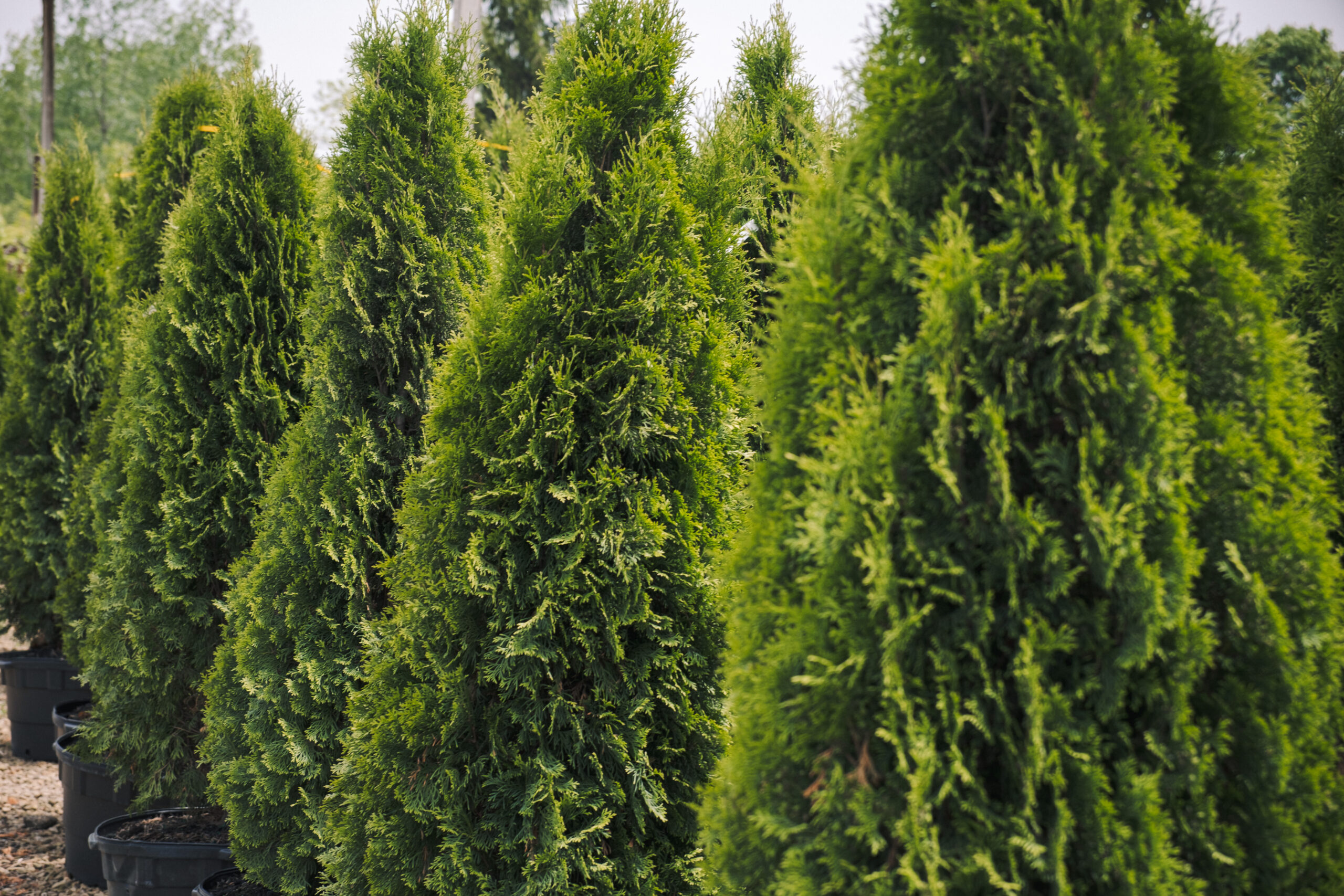
Then sometimes these fields, when we’re talking thousands and thousands and thousands of trees, they don’t always get trimmed and maintained at the same time. What I’m looking for is one that’s been pruned, one that’s full on all sides. Sometimes you’ll come to a field where the trees have grown together, where they’re going to be flat on the one side where they’re touching. The tree will recover, round back out over time, but I want a good one right from the get go. And I want the 10th one just as nice as the first one.
So we probably bring in 30, 40 semi loads in the springtime to completely fill the nursery. It depends on the size of the trees we’re tagging, but we’ll get anywhere between a hundred to 130 trees on a semi. I mean, when we’re up there, we’re tagging, you want to make it worth your while. You don’t want to go up there and only tag 12 trees.
Questions? Email us at [email protected] or call one of our two locations: Portage (330-499-0101) or Everhard (330-492-1243).
