
We’re Getting More & More Trees! Featuring the Witch Hazel Tree
We’re bringing in those hundreds of trees in the spring and then we pot them up. Instead of sticking a plant like that in the ground and then the burlap rots off the ball by midsummer, we can put it in a container. It roots out in that container, and then when you come in to purchase it, you take the entire plant root system and all to the house.
Survivability is much better that way. And the speed at which we can wait on customers is significantly faster. It takes a lot longer to dig one out of the dirt than to slide a pot onto a machine and put it in the back of a car.
We’ve learned over the years things to create more efficiency, how to cut costs as much as possible, to keep the pricing down as low as we can keep it. And when we’re looking at different species, we have such a variety of stuff. Now, we may not have huge numbers of, let’s say the weird stuff or the unique stuff.
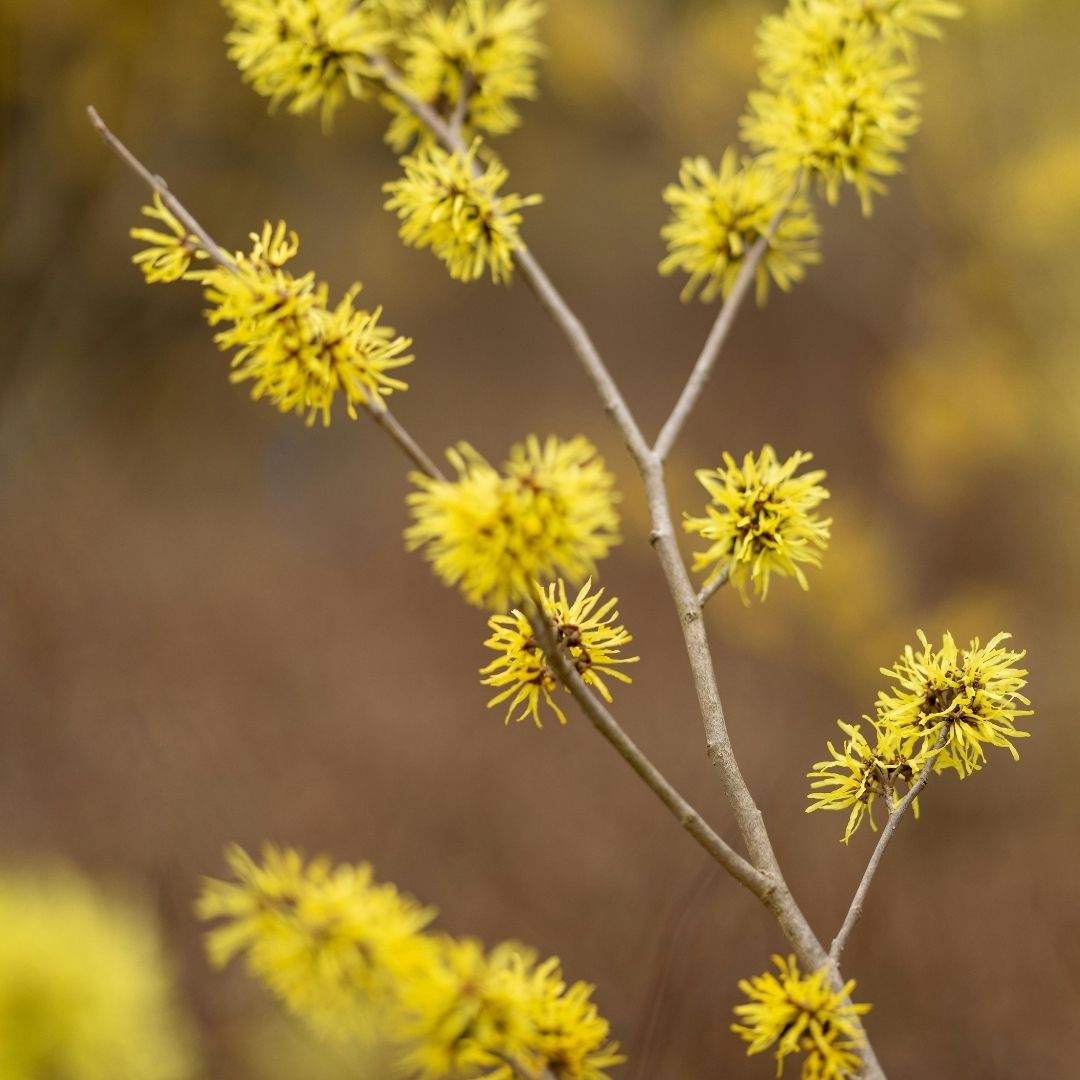
We have a witch hazel tree. Now, witch hazels are usually bushes when they’re young. They’re kind of like a magnolia. And then as they get bigger, people consider them a tree because they limb the bottom limbs up. Well, somebody actually took that plant and grafted it onto a standard, so it becomes like a miniaturized tree. It’s blooming right now.
It’s the first plant to bloom. And they’re native, so they’re very hardy. End of February, beginning of March, it flowers. It flowers about two, two and a half weeks before the forsythia flowers. A lot of people associate the yellow forsythia bushes as like the first sign of spring. It’s actually the witch hazel. The witch hazel is the first one to announce that spring is on its way. Yeah. If you go around in the woods sometimes this time of year, you’ll see them.
They’re usually yellow or an orange flower, but they have hybridized them now to where there’s reds and some other colors, too. And they’re not very big and they don’t get very big.
And how tall do they get? It depends on the variety. The ones we have there, I believe, are Arnold’s Promise, which is a really popular one. They’re going to get about eight feet tall, but they can be trimmed and kept smaller than that. It is one that takes well to being pruned. And they’re not a lot of insects or diseases that mess with a witch hazel. One of the reasons it’s a native.
Somebody could come and get one and plant it right now. Our crews are actually doing jobs and stuff right now in between the raindrops. And we’ll be unpacking the containers out of the hoop house. I think we’ve got some small container trees in there and that’ll probably get unpacked next week or the week after.
Questions? Email us at [email protected] or call one of our two locations: Portage (330-499-0101) or Everhard (330-492-1243).