
Pruning Macrophylla Hydrangeas With Stem Dieback
Carol in Canton says, ‘Good morning, I have two questions. One, I’ve called before about my hydrangeas, but I’m really frustrated with them towards fall. Well, they didn’t do well at all last year and I’m thinking of cutting them way back this spring to maybe a foot tall. They’re very close to each other and I’ve always been hesitant to trim them. If I cut them that short, is that going to kill them? The flowers are round and a pinkish blue.”
If it’s a mixture of that pinkish blue then that is in the macrophylla family. They sound like they’re older too.
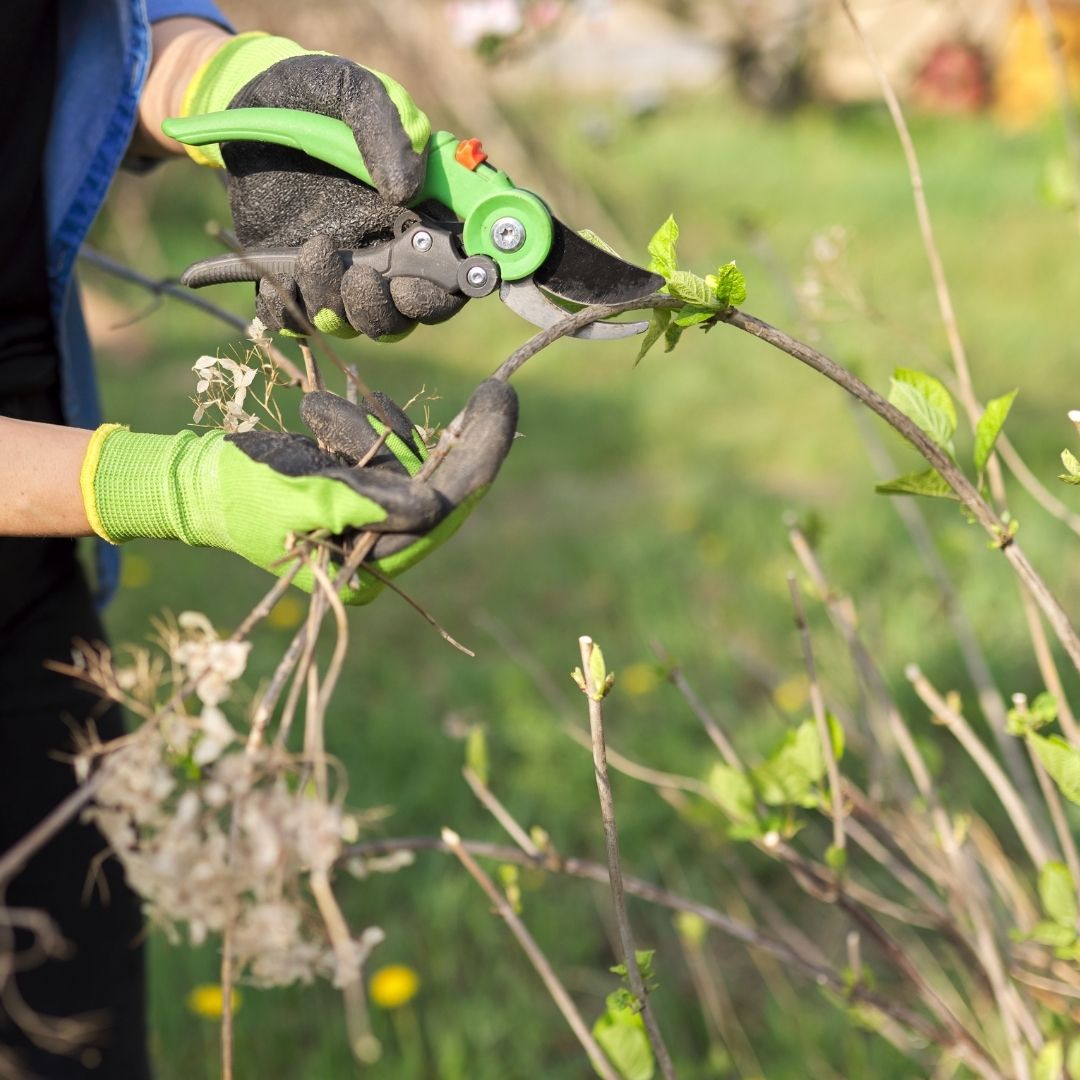
Last year I did this with mine. A lot of people either don’t trim them or just trim them with hedge shears. Ideally the best way to trim a macrophylla is to take the edge of the pruner blade and scratch the stem. You start at the tip and if it’s not green, you go down a little lower, scratch it again, go down a little lower, and scratch it again.
And what you’ll find is there are a lot of stems inside there that have died over the years. So there’s all this dead matter that’s in there and it blocks light, it blocks airflow and prevents nutrients from getting down into the soil. So trimming it one stem at a time with a pair of pruners, checking each stem, is what we would recommend.
Especially to revitalize an old one, it takes a little bit of time and some patience. Then after you’re done doing the pruning, once we get into mid-April, then you’re going to use a lot of the all-season fertilizer. For an old established hydrangea, at least three scoops. And there’s a scooper in each container. It’ll last for six months, so it’ll feed it for the entire growing season. That’s once in the spring and you’re done.
That kind of thing, if you haven’t pruned it in a long time and you’re going to do this type of pruning, take all of the dead wood out, take any crossing branches out, and then you’re going to trim the top down. Say it’s maybe three feet tall you want to take it down to maybe 15-18 inches, that would be fine.
You definitely want to take the time to prune it one stem at a time. I did mine last year at my house. Those have also been in the ground probably 15 years. And I hadn’t done it in probably seven or eight years. And so it took me probably 20 minutes to a half hour per plant, but boy did that plant do a ton better last year, because it had all the things that it was lacking.
Paniculata Variety Pruning
And again with other types of hydrangeas, when people call and ask a question like that, depending on what type of hydrangeas, it really depends on how I formulate that answer.
If it would have been a paniculata variety, which are the ones with the cone-shaped flowers, you can get pretty aggressive with those. You’re not going to hurt them, you’re not going to affect the blooming for the next year. And you can take them way back. If they were five foot tall and you take them back to two foot tall, they’ll be five foot tall again by mid-summer, because the root system has enough energy being sent up that it’ll send some big shoots.
We had a dry winter, dry summer last year. The macrophylla really likes a lot of water too. A lot of the bigger, glossier leaf plants, you know, they usually they suck up a lot of water. If we had a super dry summer and fall and if there was a lot of dead matter in there, it sheds that water to the outside and it doesn’t let it get down into the root system.
That’s why there’s a specific type of pruning with that plant. You don’t get that dieback with oak leaf hydrangea or paniculata hydrangea, like your Bobos or your Limelights. They don’t have that stem dieback like a macrophylla like an Endless Summer, a Twist and Shout or a Summer Crush.
They experience stem dieback in our winters here, and it’s not even always in the winter. Sometimes in the spring, we’ll warm up, the sap will start flowing up the stems, and then we’ll go back down to 18 degrees and it freezes, so it’s nothing that you’re doing wrong, it’s just the way that plant is in our environment here. Now down in Cincinnati further south, they’re not going to have that same issue we have up here. It is hardy here, it just requires a little bit more on the pruning end of things.
Deer
The funny thing is too, the deer like the macrophylla. I don’t really think they eat the paniculatus, but they definitely, in a winter like this where things were covered, they will eat the paniculatus. It’s not their first choice. The macrophylla is.
They’ve been in my yard chewing on mine, they even hit my liriope this week. I was surprised too, but but it was up above the snow when the yard was still covered last week, they’re like, ‘oh look that looks green’ because liriope is considered a semi evergreen, so it still had green moisture nutrients in those stems and so they came right up next to the deck and just mowed one down. That doesn’t bother me because I’m chopping all those back to like a two-inch stubble here in the next couple weeks anyways, so have at it.
Questions? Email us at [email protected] or call one of our two locations: Portage (330-499-0101) or Everhard (330-492-1243).